In Asia’s fast-growing market for shelf-stable beverages, ensuring microbiological safety and long shelf life is essential. Depending on the beverage’s acidity and sensitivity to microorganisms, manufacturers typically rely on two major filling technologies: aseptic filling and hot fill.
- Aseptic packaging involves sterilizing the product and container separately (eg. Ultra High Temperature – UHT – treatment) before combining with packaging them in a sterile environment. This is ideal for delicate products requiring long shelf life without refrigeration – a key advantage for distribution schemes which do not offer refrigeration.
- Pasteurized and ESL (Extended Shelf Life) filling solutions are typically used for refrigerated beverages that require a fresher taste, which is achieved by using a less intense thermal treatment. The end-product supply chain relies on refrigerated distribution and cold chain logistics.
- The Hot Fill method is an effective third way applying to acidic beverages that allows to achieve longer shelf life in ambient conditions by taking advantage of the natural PH profile of the drink. It is increasingly popular for the packaging of ready-to-drink beverages and juices.
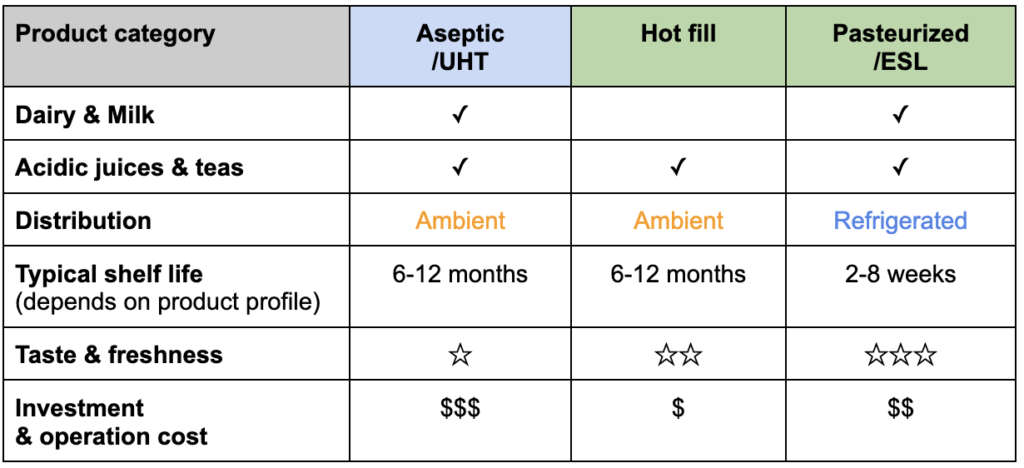
Key technical differences between the 3 hygienic processes
In beverage manufacturing, choosing between asceptit/UHT, pasteurized/ESL and Hot fill technologies is a strategic decision dictated by product positioning, product chemistry, investment capacity and operational efficiency.
Aseptic remains a common solution for low-acid products distributed in ambient conditions, such as school milk cartons. This ensures total product safety but necessitates a substantial capital investment, specialized operators, and complex daily maintenance.
As Asia’s cold chains are strengthening and middle classes’ appetite for premium products is increasing, the fresh dairy section in supermarkets is growing significantly. The fresh dairy aisle products typically rely on the Pasteurized/ESL method. The product still receives a heat treatment and is packaged in hygienic conditions (ESL). The is less complex to operate than UHT, and requires less investments. This packaging method allows to preserve the freshness and taste of the original product, making it suitable for a premium positioning.
The Hot Fill offers a third way for acidic beverages which is well suiting tropical juices and herbal teas prevalent in the Asian market. Rather than relying on a pressurized sterile chamber, this method utilizes the product’s natural acidity (pH below 4.6) combined with thermal energy (filling occurs at approximately 90°C) to decontaminate the packaging. During production, the hot liquid is filled, the carton is sealed, and the container is inverted to ensure the liquid naturally sterilizes the inner cap. It delivers comparable shelf life to UHT for acidic beverages, while significantly reducing machinery complexity, maintenance downtime, and capital expenditure.
How Hot Fill thermal processing delivers results
The hot fill method is a cost effective solution for extending the shelf life of room-temperature beverages like fruit nectars, flavored waters, and the ready-to-drink (RTD) teas widely consumed across Asia.
The success of this method depends on the thermal treatment applied prior to filling. Typically, the product is heated to a range of 90°C to 95°C for 15 to 30 seconds. This specific temperature window is critical for neutralizing pathogens while accounting for variables such as the product’s pH and microbial profile.
In a professional production environment, hot fill requires synchronized control over both the liquid and the packaging. This includes ensuring containers and closures are properly sterilized by the heat of the product itself. Furthermore, because pH levels directly dictate the thermal processing requirements, regular monitoring with calibrated pH meters is a non-negotiable standard. For producers in tropical regions, this rigorous control is essential to ensure a product remains stable from the factory floor to the end consumer.
Galdi’s Hot Fill process: full control through innovation
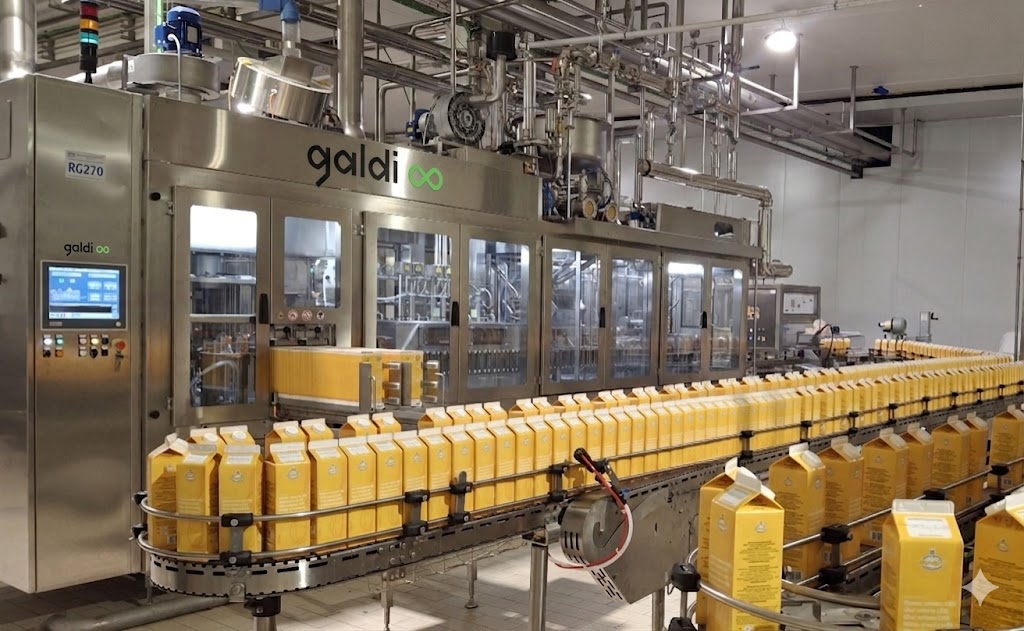
Galdi utilizes advanced hot fill technology to support the production of a wide range of non-carbonated beverages, including fruit juices, tomato sauces, and specialty teas.
The process begins by subjecting the beverage to a high-temperature treatment, typically ranging from 80°C to 90°C. This thermal exposure is critical for inactivating microorganisms, such as heat-sensitive bacteria, yeasts, and molds. Following this treatment, products are hermetically sealed within the packaging. This airtight seal is essential to prevent recontamination from external environmental factors, ensuring the product remains secure and stable after the packaging process is complete.
The rapid cooling phase following the seal is a vital component of the hot fill process, stabilizing the beverage to maintain its sensory quality. This cooling step preserves the flavor and nutritional profile while creating a vacuum inside the container. Maintaining this vacuum is essential for extending shelf life, as it minimizes oxygen levels that lead to oxidation and spoilage. For the Asian market – where vibrant colors and authentic tastes are highly valued – this process ensures that beverages retain their appeal over time.
Galdi’s application of hot fill technology reflects a commitment to safety and operational efficiency. By offering an economically viable and reliable solution, Galdi enables producers to deliver long-lasting products without compromising on quality or safety standards.
Contact us for more information and equipment quotes.